


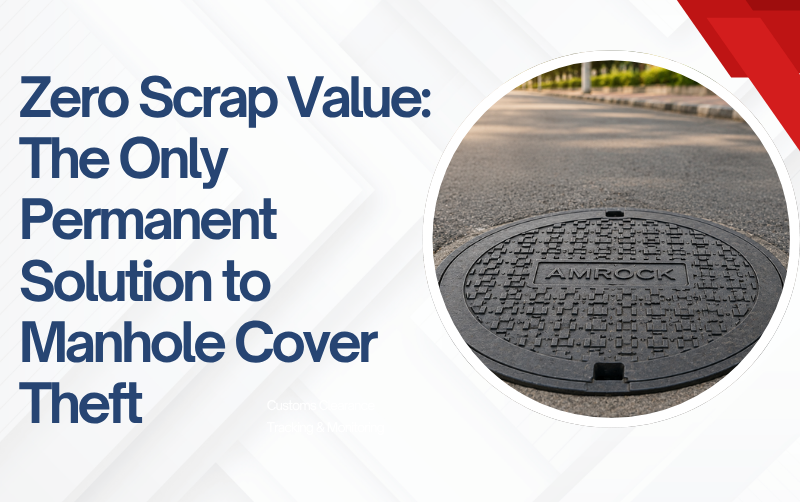
Zero Scrap Value: The Only Permanent Solution to Manhole Cover Theft
The Manhole Cover Theft Problem Costing Cities and Industries
Ask any municipal works department or plant maintenance lead about missing manhole covers and you'll get a tired look. It's a chronic drain, not a one-off. Covers vanish from roadsides, drainage networks, and industrial yards, and the pattern is almost always the same: it happens where nobody is watching. Quiet service roads, back lots, utility corridors on the edge of a facility, stretches with no cameras and infrequent patrols. A crew installs a cover one week and comes back to an open hole the next.
The reason is simple economics. A cast iron manhole cover is a slab of recyclable metal sitting in the open, and scrap dealers pay by weight. Steel behaves the same way. The cover isn't being stolen because someone needs a manhole cover; it's being stolen because it converts to cash the moment it hits a scrap yard. That single fact drives the entire problem.
The consequences land in three places, and none of them are trivial. An open manhole is an immediate safety hazard for pedestrians, cyclists, and vehicles, and the danger is worst at night in exactly the low-light areas where theft is most common. Every stolen cover is also a replacement cost, and when the same locations get hit repeatedly, that cost compounds fast. Sitting underneath both is liability exposure. When someone is injured at an uncovered opening, the question of who was responsible for that missing cover becomes expensive quickly.
Why Cast Iron & Steel Covers Are Prime Theft Targets
Scrap value is the root driver, full stop. Cast iron and steel both carry a real per-kilo resale price, and a standard cover holds enough metal to be worth the trip to a dealer. The heavier the cover, the bigger the payout, which is a perverse incentive: the more robust the traditional product, the more attractive it is to steal.
The effort-to-reward math also favors the thief. Lifting a cover takes a bar and a few minutes, with no specialized tools needed, and once it's out it's indistinguishable from any other scrap metal in a load. Locking mechanisms and hinged designs raise the effort a little, but they don't change the underlying incentive, and a determined thief works around them. As long as the material itself is worth money, the target stays painted on it.
A cover with zero resale value has zero theft incentive.
That line is the whole argument in one sentence. Every anti-theft measure bolted onto a metal cover is fighting the symptom. The clean fix is to remove the reason the cover is worth stealing in the first place.
How FRP Manhole Covers Remove the Scrap Incentive Entirely
No scrap value at the source
-
A FRP manhole cover is built from fibre-reinforced composite, not metal.
-
There's no melt value, no per-kilo scrap price, nothing a dealer will pay for.
-
Walk one into a scrap yard and you'll be turned away.
-
That's the point. The incentive that drives the theft doesn't exist for a composite cover, so the cover stays where it was installed.
What metal covers demand instead
-
Compare that to what a metal cover asks of you.
-
With steel or iron, you're committing to an ongoing defense: locks, tracking, patrols, cameras, replacement stock on the shelf for when those measures fail.
-
All of it is managing a vulnerability that never goes away, because the vulnerability is the material.
-
FRP doesn't need that scaffolding, because there's nothing to defend against at the source.
The impact on the maintenance ledger
-
The practical impact shows up on the maintenance ledger.
-
Cut out the repeat theft-and-replace cycle, and you cut out the labor to re-excavate and re-fit, the emergency call-outs to secure open holes, and the standing inventory you keep because you know covers will go missing.
-
For a network with a long history of losses in specific hotspots, switching those locations to a FRP manhole cover often pays for itself on avoided replacements alone.
-
As a FRP covers and frames manufacturer, that's the case we make to procurement teams who've been buying the same cast iron covers for the same stolen locations year after year.
Cast Iron vs FRP Manhole Covers: A Side-by-Side Comparison
Weight
-
Weight is the first thing installers notice.
-
FRP covers are substantially lighter than cast iron of the same dimensions, which makes them easier and safer to handle on site, resulting in fewer lifting injuries, faster fitting, and less strain on the frame and surrounding structure over time.
-
A two-person cast iron lift often becomes a one-person job.
Corrosion
-
Corrosion is where the material gap is starkest.
-
Iron rusts, and in wet, humid, or chemically loaded environments it degrades from day one, which is why so many old covers seize into their frames and crack at the edges
-
FRP doesn't rust. Moisture, sewer gases, and chemical exposure that eat away at metal leave the composite unaffected, so the cover you install is the cover you still have a decade later.
Load Capability
-
On load capability, FRP covers are engineered to meet the load classes their application calls for, from pedestrian walkways up through vehicular traffic areas.
-
The right rating depends on where the cover sits, so specify against the actual traffic the location sees and confirm the load class with your supplier before ordering, rather than assuming one grade fits every position.
Cost
-
Cast iron usually wins on sticker price, and it's fair to acknowledge that.
-
The comparison changes when you look at the cost of ownership over the life of the asset.
-
Add up repeated theft losses, replacement covers, the labor around each incident, and corrosion-driven failures, and the cheaper-upfront option frequently becomes the more expensive one.
-
As a FRP manhole cover manufacturer in India, we rely on exactly these high-loss situations to make our case; the pitch isn't that FRP is cheaper to buy, it's that it's cheaper to own where theft and corrosion are in play.
Where FRP Manhole Covers Make the Biggest Difference
Municipal and public infrastructure
-
Municipal and public infrastructure in high-theft or low-surveillance areas is the clearest case.
-
If a location has a history of losing covers, or if it's simply too remote to monitor, the composite cover ends the cycle instead of managing it.
-
These are the spots where a metal cover is a recurring line item and a FRP cover is a one-time fix.
Industrial plants, ports, and remote sites
-
Industrial plants, ports, and remote sites with limited security coverage sit in the same bucket.
-
Large footprints, long perimeters, and stretches with no eyes on them are hard to police, and a theft-proof cover removes a category of problem from the security team's plate entirely.
Water and sewage utilities
-
Water and sewage utilities feel this at scale.
-
When you're responsible for thousands of covers spread across a service area, you can't watch all of them, and losses across a distributed network add up.
-
Standardizing vulnerable positions on FRP takes the scrap incentive off the table network-wide.
Coastal and corrosive environments
-
Coastal and corrosive environments get a double benefit.
-
Here the composite is both theft-proof and corrosion-proof, so a single specification decision solves two failure modes at once; the salt air that would destroy iron does nothing to FRP, and there's still nothing for a thief to sell.
Technical Specification Checklist for FRP Manhole Covers
Load class
-
Confirm whether the position is pedestrian, light vehicular, or heavy vehicular, and match the cover's rating to the heaviest traffic it will realistically carry.
-
Getting this right up front is the difference between a cover that lasts and one that's underspecified for its location.
Frame material and mounting type
-
Specify the frame material and mounting type alongside the cover.
-
The cover and frame work as a system, and the mounting detail, including how it seats, how it's fixed, and how it interfaces with the surrounding surface, affects both fit and long-term stability.
-
Order them as a matched set rather than mixing components.
Standards and compliance
-
Reference the codes that apply to your project and confirm directly with the supplier which standards a given product meets before you write it into a spec.
-
Don't assume a certification; verify it against the actual product documentation so what you publish or tender is accurate.
Surface finish and anti-slip (pedestrian zones)
-
For pedestrian zones, call out the surface finish and any anti-slip requirement.
-
Covers in walkways, plazas, and other foot-traffic areas need a finish that holds grip when wet, so make that an explicit line in the specification rather than an afterthought.
Key Takeaway (TL;DR)
Manhole cover theft is driven almost entirely by one thing: scrap resale value. Cast iron and steel covers are worth money by weight, so no lock, camera, or patrol fully removes the incentive to steal them. A FRP manhole cover has no scrap value, which eliminates the motive at the material level instead of trying to defend against it. Weigh the repeated cost of stolen and corroded metal covers, plus the safety liability of open holes, against a single switch to composite; for high-loss and corrosive locations, the math usually points one way.
Talk to AMROCK about FRP manhole covers for your project.