


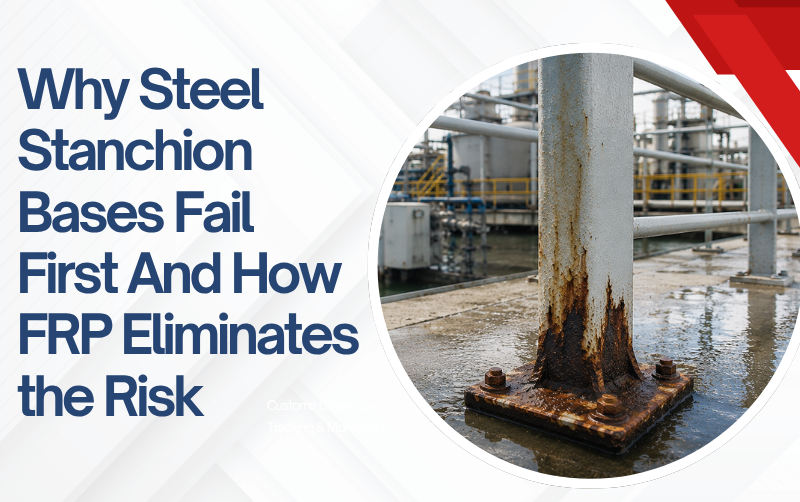
Why Steel Stanchion Bases Fail First And How FRP Eliminates the Risk
The Failure Point Most Handrail Inspections Miss
Walk a handrail line during an inspection and your eye goes to the top rail, the mid-rail, the welds you can see at standing height. The part that usually fails first is the part nobody looks at: the stanchion base, where the post meets the floor or deck. That's the interface carrying the whole system, and it's the one that lives in the worst conditions.
Water finds the low point. Moisture pools at ground level and lingers around the base long after the rest of the structure has dried, so corrosion starts there and gets a head start measured in years. It's common to find a rail that looks perfectly sound at eye level while the base plates are quietly rusting through underneath. That mismatch is exactly why base-level material choice matters more than most specifiers assume; the weakest point of a steel handrail system is the point that sees the most standing water and the least attention.
Why Steel Stanchion Bases Corrode First
The moisture story is the core of it. Along the rail, water runs off and the surface dries between exposures. At the base it collects, sits in the joint between plate and floor, and wicks into fasteners and edges, so the base is wet for far longer than any other part of the run. Corrosion is a function of time-of-wetness, and the base wins that contest every time.
Galvanic corrosion adds a second mechanism. Where a steel base plate contacts a dissimilar metal, or sits on concrete with embedded rebar, you've set up the conditions for galvanic attack at the very joint that's already staying wet. The electrochemical reaction accelerates loss right where the load is transferred into the floor.
Coatings don't survive there either. The protective layer at the base wears fastest. Foot traffic scuffs it, pooled water attacks it, and wash-down and cleaning chemicals strip it, so the one location that needs its coating intact is the one that loses it first. Once bare steel is exposed at a wet, chemically loaded joint, the corrosion clock runs fast.
How FRP Stanchion Bases Remove the Corrosion Mechanism Entirely
Fiber Reinforced Plastic doesn't rust or oxidize. Standing water at the base, the condition that destroys steel first, does nothing to a composite base; there's no iron to corrode, so the primary failure mechanism simply isn't present. The base that stays wettest is no longer the base that fails first.
It also takes galvanic corrosion off the table. FRP isn't a reactive metal, so there's no galvanic couple to form where it meets concrete, rebar, or other materials. The reaction that eats steel base plates at the joint has no path to start.
The outcome is a base that holds its integrity across the life of the system instead of becoming its weakest link. A FRP handrail keeps its strength at the connection to the floor rather than degrading from the ground up, and a FRP guardrail behaves the same way. The part carrying the load stays sound for as long as the rail is in service.
FRP vs Steel Stanchion Bases: Structural & Maintenance Comparison
Corrosion
-
On corrosion, this isn't a matter of degree.
-
Steel degrades progressively at the base, on a predictable downward curve once the coating is gone.
-
FRP doesn't degrade by that mechanism at all, so instead of managing a slow failure, you've removed it.
-
As an anti-corrosion grating manufacturer in India working across wet industrial environments, we've seen that this distinction is the whole reason FRP railing systems get specified for wash-down and coastal duty.
Structural consequence
-
The structural consequence is what makes this urgent rather than cosmetic.
-
A handrail is a safety system, and its rating depends on the posts being anchored soundly.
-
When a base corrodes, it isn't just that one post that's compromised; the load path through the whole run is weakened, and a rail that can't take the required load at its anchor points is a rail that can't do its job.
-
Base corrosion is a system-level safety problem wearing the disguise of a localized one.
Maintenance load
-
Maintenance load separates the two further.
-
Steel means recurring base inspection, coating touch-ups, and eventual plate repair or replacement, all of it concentrated at the hardest point to keep protected.
-
FRP cuts that ongoing burden substantially because there's no corrosion cycle to chase.
-
Over years, that's a meaningful reduction in inspection hours and repair spend, focused on the exact failure mode that costs the most to manage.
Where Base Corrosion Hits Hardest, And How FRP Prevents It
Wet and wash-down environments
-
Wet and wash-down environments are the clearest case.
-
Food and beverage plants and chemical processing facilities hose down floors constantly, often with aggressive cleaning agents, and that combination of standing water and chemistry attacks steel bases fast.
-
This is prime territory for a FRP handrail, where the base sees the worst of the duty.
Coastal and marine-adjacent facilities
-
Coastal and marine-adjacent facilities add salt to the equation.
-
Salt-laden air and spray accelerate corrosion sharply, and the base, already the wettest point, takes the brunt.
-
A FRP handrail manufacturer and GRP handrail supplier serving these sites specifies composite precisely because the metal alternative is on a short clock at the anchor.
Water and wastewater treatment plants
-
Water and wastewater treatment plants combine constant moisture, humidity, and chemical exposure across large railed areas.
-
With long runs of handrail in permanently wet surroundings, base corrosion becomes a plant-wide maintenance item, and moving to FRP addresses it at the source.
Outdoor rooftop walkways and platforms
-
Outdoor rooftop walkways and platforms round out the list.
-
Exposed to rain, standing water, and weather with no shelter, their stanchion bases stay wet through every wet season, making them a textbook location for base-first failure and a strong candidate for composite.
Technical Checklist for Specifying FRP Handrail & Stanchion Systems
Base plate and mounting method
-
Define the base plate and mounting method up front.
-
Decide between bolted and embedded mounting based on the floor construction and the loads involved, and specify the base plate detail explicitly, since this is the interface that carries the system and the one you least want to leave to interpretation.
Resin grade
-
Match the resin grade to the actual exposure.
-
Chemical, marine, and general industrial environments each call for a resin suited to their conditions, so specify the grade against the real chemistry and moisture at the site rather than accepting a default.
Load rating
-
Confirm the load rating against the applicable code.
-
Verify which standard governs your application and check the product's rated capacity against it, using the supplier's confirmed specifications rather than an assumption; don't write a compliance figure into a spec until it's been verified against the actual product data.
Certification claims
-
Treat certification claims the same way.
-
Only include a corrosion-resistance or product certification if the supplier genuinely holds it for that product line and can document it.
-
If it isn't confirmed, leave it out rather than implying a certification the product may not carry.
Key Takeaway (TL;DR)
The stanchion base is the earliest and most consequential failure point in a steel handrail system. Moisture pools there, coatings wear there, and galvanic attack starts there; and because the base anchors the whole run, corrosion at that one point compromises the structural integrity of the entire rail, not just a single post. FRP removes the mechanism outright: it doesn't rust, doesn't react galvanically, and holds its integrity at the base for the life of the system. A rail that looks fine above ground can still be failing at the one place that matters most for safety, which is exactly the risk composite eliminates.
See AMROCK's FRP handrails.