


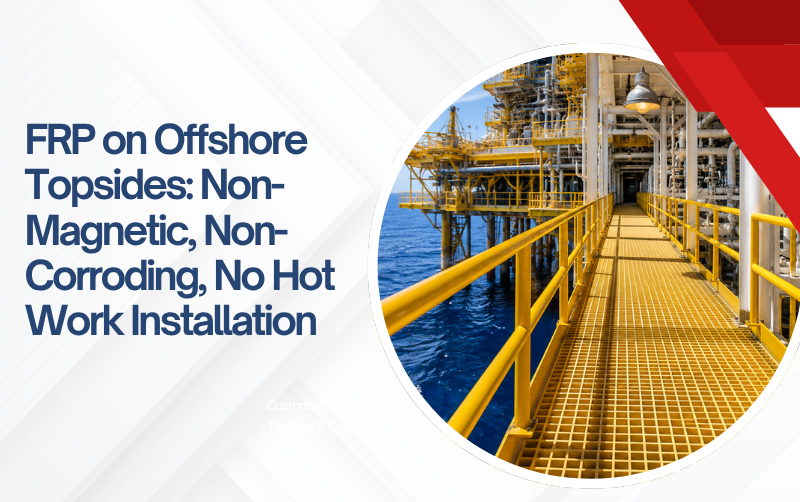
FRP on Offshore Topsides: Non-Magnetic, Non-Corroding, No Hot Work Installation
The Material Challenge Offshore Topside Structures Face
Nowhere punishes a material choice faster than an offshore topside. The environment is relentless: salt spray, driving humidity, and standing wet that never really lets up. Exposed steel structures corrode under that load continuously, and the coatings meant to protect them are fighting the same battle every hour of every day. What would take years to show on an inland structure shows up far sooner out here.
There's a second problem that's easy to overlook until it bites. Topsides are packed with sensitive navigation and instrumentation equipment, and magnetic materials in the wrong place can interfere with systems that need to read clean. Where accuracy matters, having large masses of ferromagnetic steel nearby is a design constraint, not a detail.
Then there's the work itself. Cutting and welding on a live platform is hot work, and hot work near hydrocarbons carries real fire and explosion risk. That risk translates into permits, gas testing, standby crews, and stoppages, adding a heavy safety and scheduling overhead layered onto every steel installation or repair. Put the three together and material choice offshore isn't a preference. It decides how safe, how fast, and how maintainable the structure will be for its whole life.
Why Steel Struggles on Offshore Platforms
Steel corrodes offshore no matter how well it's finished. Galvanizing and multi-coat paint systems slow it down, but salt spray works into every edge, fastener, and coating holiday, and once the protective layer is breached the corrosion runs underneath it. The result is a maintenance commitment that never ends: inspect, blast, recoat, repeat, for as long as the steel is in service.
The magnetic issue is structural to the material. Carbon steel is ferromagnetic, so wherever it sits near instrumentation or navigation systems it introduces a potential interference source the design has to account for. You can manage around it, but you can't make steel non-magnetic.
Installation and repair timelines take the biggest hit. Because working steel usually means welding, and welding on a producing platform means hot work, every modification runs through the permit-to-work system with all the friction that entails. On a live, operational topside where shutdowns cost real money, that friction stretches schedules and complicates otherwise routine jobs.
How FRP Solves All Three Problems at Once
Non-magnetic composite
-
FRP is a non-magnetic composite.
-
There's no ferromagnetic content to interfere with instrumentation or navigation equipment, so it can be installed close to sensitive systems without introducing a magnetic source into the design.
-
For congested topside layouts, that removes a constraint rather than working around it.
Non-corroding
-
It also doesn't corrode.
-
Saltwater, humidity, and the chemical exposure that come standard on a topside don't degrade the composite the way they degrade steel, which is why non-conductive industrial grating India suppliers point offshore operators toward FRP for the wettest, most aggressive locations on the platform.
-
The material that would be a maintenance liability in steel is largely inert here.
Installation advantage: no hot work
-
The installation advantage is the one project managers feel first.
-
FRP assembles with mechanical fasteners, bolted connections, clips, and clamps, so a standard build needs no welding and therefore no hot work.
-
Take hot work out of the sequence and you take out the permits, gas testing, and standby that surround it, which is a large part of why FRP grating for oil and gas keeps displacing steel on live platforms.
-
The work goes faster and carries less risk because the ignition source was never introduced.
FRP vs Steel on Offshore Topsides: Key Differences
Weight
-
Weight is the headline difference.
-
FRP grating is significantly lighter than equivalent steel, which reduces the dead load the structure has to carry and makes everything about transport and lifting easier offshore.
-
Fewer crane picks, lighter modules, and panels a small crew can handle by hand all matter when deck space and lifting windows are constrained.
Maintenance
-
Maintenance is where the lifetime gap opens up.
-
Steel demands recurring anti-corrosion work, inspection, surface prep, and repainting on a cycle that never stops as long as it's exposed to salt.
-
FRP asks for very little by comparison, because there's no corrosion process to stay ahead of.
-
Over a platform's operating life, that's a large recurring cost and a lot of offshore man-hours that simply don't get spent.
Safety
-
Safety adds a further margin.
-
FRP's non-conductive, spark-free character reduces ignition risk in hazardous, ATEX-type zones where a stray spark is a genuine hazard.
-
In classified areas, a material that won't carry current or throw a spark is doing safety work steel can't.
Cumulative impact
-
Add it up across the life of the structure, and the cumulative cost and downtime savings are substantial: less corrosion maintenance, less hot-work stoppage, easier logistics, and lower ignition risk, compounding year after year rather than showing up as a single line on the purchase order.
Where FRP Is Used Across Offshore Topside Structures
Walkways and access platforms
-
FRP Walkways and access platforms are a natural fit.
-
These see constant foot traffic and constant salt exposure, and as a FRP grating walkway manufacturer, we see them specified in composite precisely because they combine the wet, corrosive duty with the need for a light, easy-to-install deck.
Handrails and guardrails
-
Handrails and guardrails around hazardous or high-traffic zones are another common application.
-
A FRP handrail doesn't corrode at the connections the way steel does, and as a FRP handrail manufacturer and GRP handrail supplier serving offshore projects, the pitch is straightforward: the safety barrier stays sound in the exact wet, salty conditions that attack metal railing first.
Gratings for flooring and equipment platforms
-
Gratings for flooring and equipment platforms carry personnel and equipment loads across the topside, and FRP walkway grating handles that duty while shedding weight and shrugging off corrosion.
-
It's the workhorse application and usually the largest by area.
Cable trays
-
FRP Cable trays for instrumentation and power routing round out the set.
-
Running non-corroding, non-magnetic trays for cabling keeps the routing infrastructure sound and, given the non-magnetic property, avoids introducing interference near the instrumentation the cables serve.
Technical Specification Checklist for Offshore-Grade FRP
Resin system
-
Start with the resin system.
-
Offshore duty calls for a resin suited to sustained saltwater and chemical exposure, so confirm which offshore-grade resin options your supplier actually offers and match the grade to the specific exposure at each location rather than defaulting to a general-purpose resin.
Fire-retardant grade
-
Specify the fire-retardant grade your topside safety requirements demand.
-
Fire performance is not optional on a platform, so make the required grade an explicit line in the specification and confirm the product meets it before it goes into a tender.
Load rating
-
Set the load rating to the real duty.
-
Personnel access, equipment platforms, and traffic areas carry different loads, so rate each application for the actual personnel and equipment traffic it will see rather than applying one number everywhere.
UV stabilization
-
Account for UV.
-
Topside structures sit in prolonged, unshaded sun at sea, so specify UV stabilization appropriate to that exposure so the material holds up over years on deck, not just through the first season.
Key Takeaway (TL;DR)
Offshore topsides stack three material risks on top of each other: relentless corrosion, magnetic interference near sensitive instrumentation, and the safety and schedule cost of hot work on a live platform. FRP is one of the few materials that answers all three at once; it doesn't corrode, it isn't magnetic, and it bolts together with no welding. Weigh steel's endless recoat cycle and permit friction against a largely maintenance-free, weld-free FRP installation, and on most topsides the composite is the lower-risk, lower-cost choice over the life of the asset.
Explore AMROCK's offshore-applicable products: FRP gratings, FRP handrails, and FRP cable trays.