


FRP Grating Full Form and Meaning: A Quick Guide for First-Time Buyers
FRP Full Form: What the Letters Actually Stand For
The FRP grating full form is Fibre Reinforced Plastic, also written Fibre Reinforced Polymer depending on who you ask. It refers to a composite material: a polymer resin reinforced with glass fibres, where the resin holds everything together and the glass gives the material its strength and stiffness. Neither part does the job alone; the combination is what makes FRP structurally useful.
You will also see GRP, Glass Reinforced Plastic, used in the same conversations. For most practical purposes GRP and FRP describe the same underlying material, and the terms are often used interchangeably. If a datasheet says GRP and your spec says FRP, that difference in wording is usually not a difference in material.
What "Grating" Means in This Context
A grating is an open, load-bearing flooring or walkway structure, usually built in a grid pattern. The grid is what defines it: the open cells let air, water, and light pass through while the surrounding structure still carries foot or vehicle traffic. It is the same idea as a metal floor grating, just made from composite instead of steel.
The open design is deliberate, not a compromise. On a platform or walkway you often want drainage, ventilation, or light to reach below, and a solid panel blocks all three. So when you compare FRP gratings to a solid floor panel, the gaps are a feature that suits the application, not a weakness in the product.
How FRP Grating Is Made
There are two common ways to make it, and they produce noticeably different products. Moulded grating is cast in an open mould, where resin and glass fibre are laid up to form a one-piece panel with bidirectional strength. Pultruded grating is made by pulling continuous glass fibre through a resin bath and a heated die, producing strong load-bearing bars that are then assembled into panels.
Each process suits a different set of load and application profiles, and the choice between them is a real engineering decision rather than a preference. That trade-off between moulded and pultruded is covered in more depth in AMROCK's other grating content, so it is not repeated in full here. As a working manufacturer and fiberglass grating manufacturer in India, the short version is that the right process depends on span, load, and how the grating will be used.
Why Industries Choose FRP Grating Over Steel
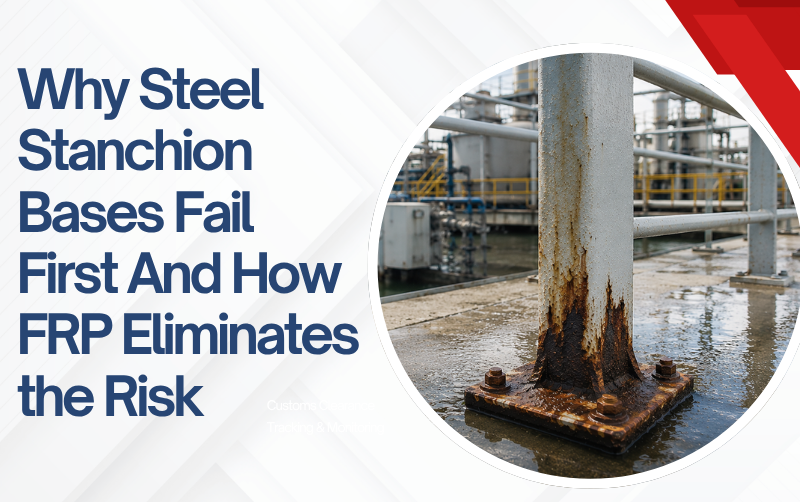
The main reason is corrosion. FRP does not rust, so it holds up in humid, wet, or chemically aggressive environments where steel grating needs coating, maintenance, and eventual replacement. In a chemical plant or a coastal facility, that difference shows up directly in maintenance cost and service life.
Weight is the second reason. FRP grating is significantly lighter than the steel equivalent, which makes it easier to handle, transport, and install, often without heavy lifting equipment. The third is that FRP is non-conductive, which matters in electrical and certain hazardous-area applications where a conductive walkway is a safety concern. Together those three properties are why FRP keeps replacing steel in specific settings, rather than everywhere at once.
Common Applications
You will find FRP grating anywhere corrosion, weight, or conductivity make steel a poor fit. The most common settings are:
-
Industrial walkways, platforms, and access structures
-
Chemical processing and water treatment plant flooring
-
Offshore and oil and gas structures exposed to salt and moisture
Beyond those, any facility with a wet, corrosive, or electrically sensitive environment is a candidate. Choosing the right product for a given application is where a specialist FRP grating manufacturer earns its place, since the material only performs when the grade and profile match the conditions.
Key Takeaway (TL;DR)
The FRP grating full form is Fibre Reinforced Plastic, and FRP grating is an open, corrosion-resistant, load-bearing structure used as an alternative to steel grating across industrial applications. It is chosen for three practical reasons: it does not corrode, it is lighter to handle, and it is non-conductive. If you are moving from the definition to actually specifying a product, our FRP gratings range is the next place to look.