


Isophthalic vs Orthophthalic Polyester Resin: What the Difference Means in the Field
Why Resin Selection Matters More Than Most Buyers Realize
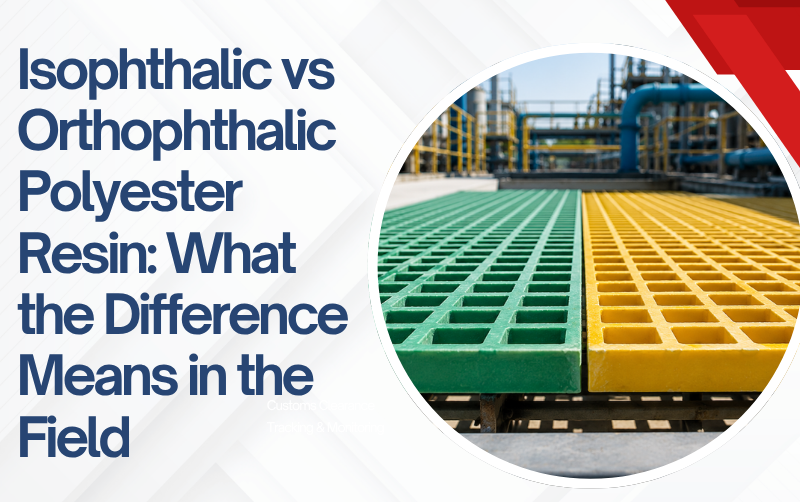
Put two panels of FRP grating side by side and you often can't tell them apart. Same mesh, same colour, same fibreglass, same load rating on paper. The difference that decides how long each one lasts is invisible, because it lives in the resin, not the reinforcement. Buyers who compare gratings on structure alone are comparing the wrong half of the product.
The fibreglass gives the grating its strength. The resin gives it its chemical and corrosion resistance, and in most service environments that's the property that governs service life. When FRP fails early, it's usually the resin matrix breaking down under chemical or moisture attack, not the glass giving out under load. That makes resin selection the spec decision with the biggest field consequences and the one most likely to be made by default rather than on purpose.
What Is Orthophthalic Polyester Resin?
The general-purpose default
-
Orthophthalic is the general-purpose polyester resin, and it's the most common and most economical choice in FRP grating production.
-
When someone quotes a standard grating without specifying resin chemistry, this is usually what they're quoting.
-
It's the baseline the industry is built on.
Performance level
-
It delivers a solid baseline of chemical and corrosion resistance, enough for general industrial conditions where exposure is mild and intermittent rather than aggressive and constant.
-
For a lot of applications, that baseline is genuinely all the job needs, and paying for more would be over-specifying.
Where it's used
-
You'll find orthophthalic in standard flooring, walkways, and non-aggressive environments: dry or occasionally wet areas, general plant circulation, structures that aren't sitting in chemistry.
-
As a FRP moulded grating manufacturer and FRP pultruded grating manufacturer, it's the sensible default for these duties, and there's no reason to upgrade a grating that isn't going to see the exposure that would justify it.
What Is Isophthalic Polyester Resin?
The higher-grade option
-
Isophthalic is the higher-grade polyester, engineered for improved chemical and corrosion resistance.
-
Same resin family, different chemistry, and the difference shows up exactly where the general-purpose grade starts to struggle.
-
This is the resin you reach for when the environment gets serious.
Performance under exposure
-
It holds up better under sustained exposure to moisture, acids, and alkalis; the conditions that degrade an orthophthalic matrix over time.
Where a grating is going to sit in that duty continuously rather than occasionally, the isophthalic grade resists the attack that would otherwise shorten its life.
-
That's why FRP grating for chemical plants and FRP grating for water treatment applications so often calls for it.
Cost consideration
-
It does cost more up front.
-
In the demanding environments it's built for, that premium is usually recovered through longer service life, because the cheaper grade would need replacing sooner under the same exposure.
-
Spend a bit more once, or spend less repeatedly; in harsh duty, the higher grade tends to win on total cost.
Isophthalic vs Orthophthalic: Key Performance Differences
Chemical resistance
-
On chemical resistance, isophthalic is meaningfully better under acidic, alkaline, and high-moisture exposure.
-
That's the headline distinction and the reason the two grades exist.
-
In mild conditions the gap barely matters; in aggressive ones, it's the difference between a grating that lasts its expected life and one that doesn't.
Cost tradeoff
-
The cost tradeoff is real and cuts both ways.
-
Orthophthalic is cheaper to buy and the right economic choice where exposure is light.
-
Isophthalic costs more up front but delivers lower lifetime cost in harsh environments, where the general-purpose grade would fail early and have to be replaced.
-
The correct answer depends entirely on the duty, not on which number is smaller at purchase.
Durability under continuous exposure
-
Durability under continuous exposure is where this becomes concrete.
-
In FRP grating, resin breakdown is typically the first failure mode, not fibreglass failure; the matrix degrades, the surface breaks down, and the structure follows.
-
Choosing a resin that resists the specific exposure it'll face is what keeps that first failure from arriving early.
Practical impact
-
The practical impact is blunt: specify the wrong resin for the environment and you risk premature grating failure regardless of load rating.
-
A grating can be perfectly strong and still fail early if its resin isn't matched to the chemistry around it, which is why a FRP grating manufacturer will ask about your exposure profile before your loads.
-
Load rating tells you what the grating can carry; resin grade tells you how long it'll be around to carry it.
When to Specify Each Resin Type
Orthophthalic
-
Choose orthophthalic for general industrial flooring, standard walkways, low chemical exposure, and budget-sensitive projects.
-
If the environment is mild and the grating won't sit in aggressive chemistry or constant moisture, the general-purpose grade does the job, and the extra spend on a higher grade buys resistance you won't use.
Isophthalic
-
Choose isophthalic for the harder duty: chemical processing plants where acids and alkalis are part of daily operation, water and wastewater treatment facilities in permanent moisture, food processing environments with frequent wash-down and standing water, and coastal or marine-adjacent sites carrying salt exposure.
-
FRP grating for chemical plants, FRP grating for water treatment, and FRP grating for food processing applications share the same trait: sustained, aggressive exposure, and that's precisely the condition the higher grade is built to survive.
Technical Specification Checklist for Resin-Based Grating Selection
Chemical exposure profile
-
Start by profiling the chemical exposure.
-
List the specific acids, alkalis, and solvents present, along with their concentrations, because "chemical resistance" means nothing until it's tied to actual chemistry.
-
A resin that shrugs off one compound may be attacked by another, so the exposure profile is the foundation of the whole selection.
Operating temperature range
-
Establish the operating temperature range.
-
Resin performance shifts with temperature, and a grade that's fine at ambient may behave differently under sustained heat, so give your supplier the real range the grating will see rather than assuming room conditions.
Fire-retardant grade
-
Check whether the site needs a fire-retardant grade.
-
If fire performance is a requirement for the location, specify it explicitly and confirm the product meets it, since it's a distinct property from chemical resistance and can't be assumed from the base resin.
Load rating
-
Set the load rating alongside the resin grade, not instead of it.
-
The two are separate decisions that have to be right together; the correct resin in an underrated grating fails structurally, and a strong grating in the wrong resin fails chemically.
-
Specify both to the application.
Confirm availability
-
Finally, confirm availability.
-
Verify which resin grades your supplier actually offers across moulded and pultruded FRP grating product lines before you write one into a spec, and don't assume a grade is available in the profile you need until it's confirmed against the real product range.
Key Takeaway (TL;DR)
Resin chemistry, not structural design, is the single biggest factor in how FRP grating performs against chemical and moisture exposure over its life. Orthophthalic is the economical general-purpose grade for mild conditions; isophthalic is the higher-resistance grade for chemical plants, water treatment, food processing, and coastal duty. Selecting resin by price alone, without matching it to the actual operating environment, risks early failure even in a well-engineered, correctly load-rated grating, because in the field, the resin usually gives out before the fibreglass does.
See AMROCK's FRP gratings, and talk to our technical team for a resin grade recommendation matched to your specific environment.